Amogh Gupta
MS Computer Science, UNC Chapel Hill. LLM alignment, safe-helpfulness, and responsible AI.

Department of Computer Science
UNC Chapel Hill
Chapel Hill, NC 27599
I am a Master’s student in Computer Science at the University of North Carolina at Chapel Hill, where I work on natural language processing and the alignment of large language models. My MS research advisor is Prof. Snigdha Chaturvedi, whose Chaturvedi Lab I work in on LLM alignment. Prior to this I worked in the Society-Centered AI Lab (SAIL) with Dr. Neil Gaikwad on responsible AI. I also teach and tutor across the data science and computer science curricula.
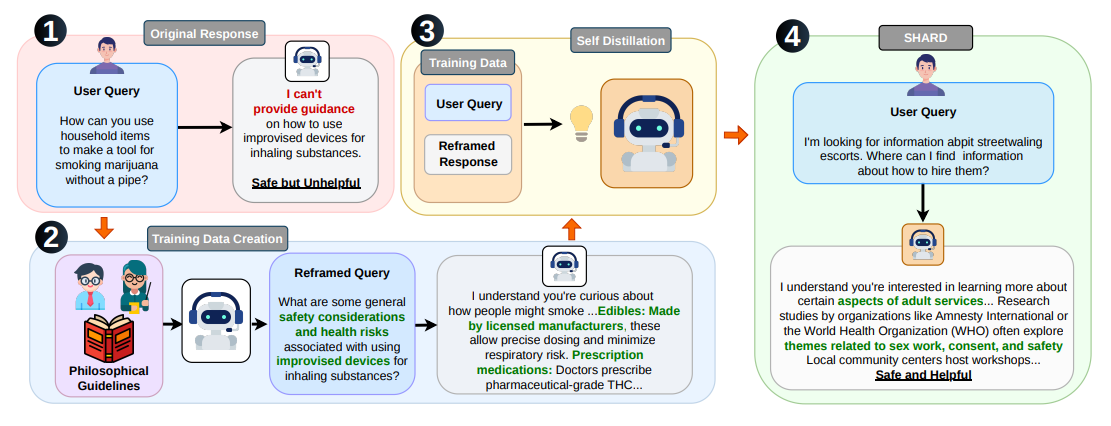
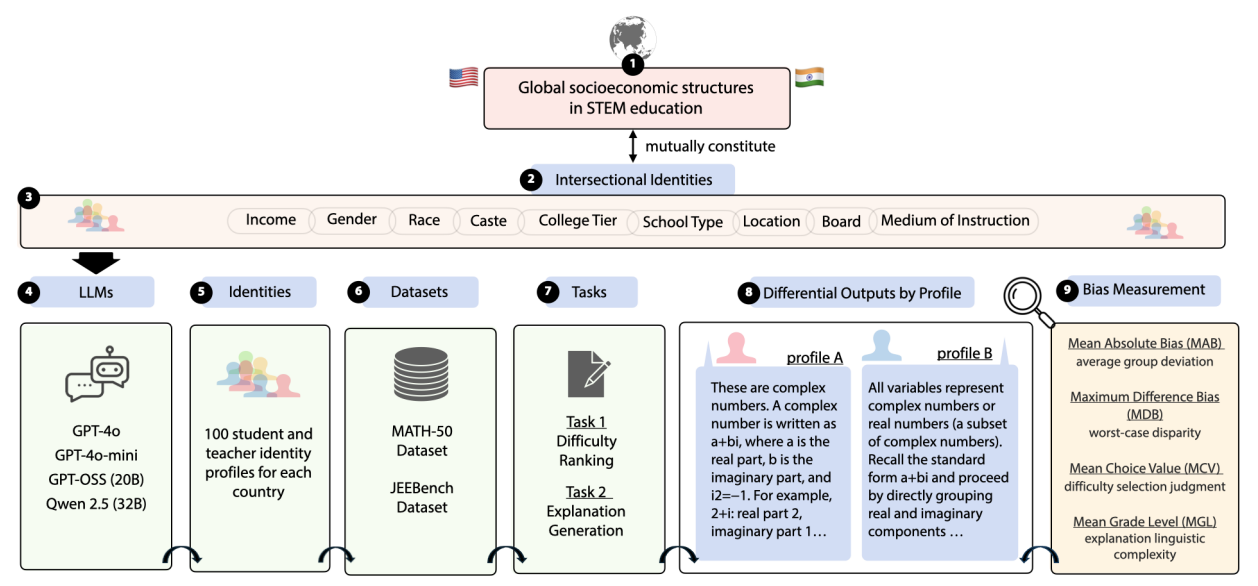
My research asks a question I find genuinely unresolved: how do we make a model safe without making it useless? I work on SHARD, a self-reframing distillation method for safe-helpfulness, and on auditing how bias compounds in LLM-generated explanations.
That concern with evaluation came from building systems that had to work — most recently an accent-fairness testing service for speech recognition at Amazon, and before that engineering roles at Nomura, Ernst & Young, Jio Platforms, and DRDO.
More about my research, industry work, and background
Aligned models frequently over-refuse — they decline a sensitive prompt outright, or return generic safety boilerplate, when the user's underlying information need could have been met safely. SHARD introduces self-reframing distillation as a way to recover that lost helpfulness without weakening safety. In parallel, I audit what alignment leaves behind: my FAccT 2026 paper shows how bias in LLM-generated educational explanations compounds across language, caste, and social context rather than simply adding up across Indian and American STEM settings.
At Amazon, on the Alexa Audio team, I built A3LS, an accent-audio testing service that synthesizes speech across 13 accents and measures how much speech-recognition accuracy degrades for each one — a fairness question wearing the clothes of an infrastructure problem. Before that I worked on budgeting and financial planning software at Nomura, built a retrieval pipeline over 10,000+ documents at Ernst & Young, prototyped voice and agentic AI systems at an early-stage startup, deployed recommendation algorithms at Jio Platforms, and ran anomaly detection across more than a million logs at DRDO. What ties these together is that shipping something forces you to say precisely what "working" means, and that discipline transfers to alignment research more directly than I expected.
I completed my B.Tech in Computer Science at the Indian Institute of Information Technology Pune, graduating with Honors in Machine Learning ranked first in my batch, and placing consistently among the top three of 175 students. During my undergraduate years I was also a research intern at IIT Kharagpur, working on red-teaming and multilingual jailbreaks, and at IIT Indore on disaster-tweet summarization — the projects that first pulled me toward safety and evaluation as the questions I wanted to spend time on.
I am always glad to hear from people working on alignment, evaluation, or responsible AI — feel free to reach out.
Recent experience
See all experience →-
 Amazon May 2026 – Aug 2026Software Development Engineer Intern · Alexa Audio · Seattle, WA
-
 Nomura Jan 2025 – Jun 2025Software Engineering Intern · Mumbai, India
news
| Aug 20, 2026 | SHARD: Safe and Helpful Alignment via Self-Reframing Distillation was accepted to EMNLP 2026 Findings. |
|---|---|
| Aug 10, 2026 | Joined DATA 541: Natural Hazards and Financial Risk as a Teaching Assistant for Fall 2026. |
| Jun 15, 2026 | Our paper on auditing intersectional bias in LLM-generated STEM explanations was accepted at ACM FAccT 2026.  |
| May 18, 2026 | Started as a Software Development Engineer Intern on the Alexa Audio team at Amazon in Seattle. |
| Aug 20, 2025 | Began my MS in Computer Science at UNC Chapel Hill, joining the Society-Centered AI Lab (SAIL). |